

How Many People Register For Diversity Lottery
More than 22.4 million people applied in 2017 to a U.S. visa program that provides fifty,000 dark-green cards, or lawful permanent residence, each year through a lottery system, according to a Pew Research Center assay of U.South. State Department data. The number of applicants nearly matched the record 23 million applicants received in 2016 and came as the Trump administration and some members of Congress have sought to eliminate the program – the only 1 of its kind globally.
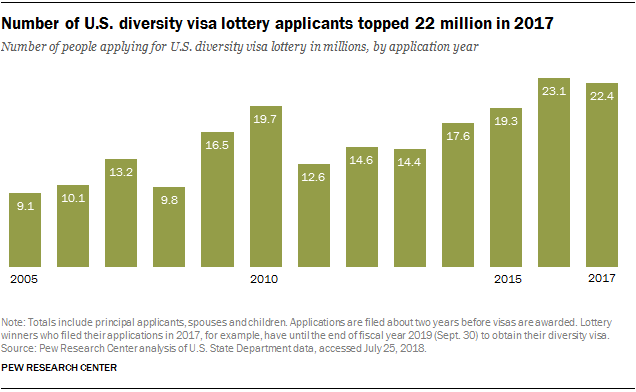
Since 2005, more than 200 million people from countries around the world have applied for the program, known as the U.S. diverseness lottery, which seeks to diversify the nation'southward immigrant population by granting visas to immigrants from nations that are underrepresented amid recently arrived immigrants.
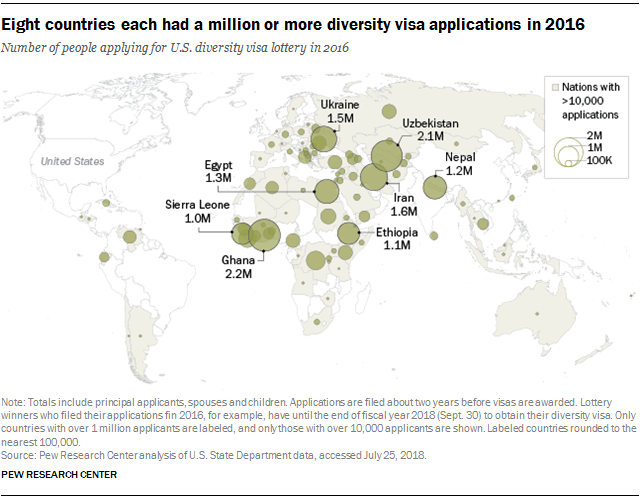
Eight countries had at least a million applicants in 2016, accounting for more than one-half of the total: Ghana, Uzbekistan, Iran, Ukraine, Egypt, Nepal, Ethiopia and Sierra Leone. (2016 is the most recent year for which land-specific information on applications are available.)
In some countries, a meaning share of the population applied for the diversity visa lottery in 2016. In Liberia, for example, nearly 15% of the land'due south citizens applied for the program. Other African countries with loftier shares of applicants included Sierra Leone (xiv%) and Ghana (8%). European countries such equally Albania (13%), Moldova (xi%) and Armenia (nine%) besides saw substantial shares of their populations submit applications. In Asia, Uzbekistan (7%) and Nepal (4%) had the region's highest shares on this measure. Overall, virtually ane% of people in eligible countries practical for the program.
Among variety visas actually issued, the regional breakdown of where immigrants come from has changed over time, according to U.S. Country Department figures. (The department sets regional quotas annually based on how many immigrants from a region have come to the U.S. in contempo years.) When the diverseness lottery first started in fiscal year 1995, citizens of European countries, including those that were function of the onetime Soviet Union, received the largest number of diverseness visas (about 24,000). In financial 2017, which ended Sept. 30, the largest number of visas went to citizens of African countries (well-nigh nineteen,000), while applicants from European countries (nearly 21,000) and from Asia (nigh 8,000) received fewer visas.
The U.S. diversity lottery accounts for a relatively minor share – well-nigh 5% – of the roughly 1 one thousand thousand people awarded green cards each year. Though small in size, the program is unusual because it places few restrictions on who can receive a green card (primary applicants must, in general, have a high school education or 2 years of recent work experience). Other nations, past contrast, prioritize work skills, family relationships or humanitarian demand when awarding lawful permanent residence. (New Zealand besides has a visa lottery plan, but it is much smaller and open only to citizens of neighboring island nations.)
How the plan works
Since fiscal 1995, diversity visa lottery applications take been accepted for several weeks each year, unremarkably quondam in the fall. Visa recipients are and then randomly selected and tin enter the U.S. roughly two years later on their initial application. For example, lottery winners who practical in the agenda year 2017 take until Sept. thirty, 2019, to obtain their diversity visa. (Detailed application statistics are only available dorsum to applications filed in 2005.)
Those eligible for the lottery face few barriers with the initial application, which has no fee, is available in many languages and asks for limited personal information. If selected for a diversity visa, however, applicants must submit to detailed background and security checks, interviews and wellness screenings and pay $330. Upon entry into the U.S., variety visa recipients are given lawful permanent residence status, which gives them permission to work and alive permanently in the U.S.
The biggest restriction of the multifariousness visa lottery is that the applicant or their spouse must be citizens of countries that accept sent fewer than 50,000 immigrants to the U.S. over the previous v years. As a result, those from United mexican states, Canada, China and India –top origin countries for U.S. immigrants in recent years – are not eligible. The list of eligible countries tin can change each twelvemonth. For example, due to increased immigration to the U.Due south., citizens of Bangladesh became ineligible for the lottery starting in 2011, and those from Nigeria became ineligible since 2013. Others can gain eligibility for the lottery if immigration to the U.Southward. slows, as was the case with citizens of Russian federation who became eligible beginning in 2008, while those from Poland could employ starting in 2012.
Note: This is an update of a post originally published March 24, 2017.

Phillip Connor is a former senior researcher focusing on demography and migration studies at Pew Research Center.

How Many People Register For Diversity Lottery,
Source: https://www.pewresearch.org/fact-tank/2018/08/23/applications-for-u-s-visa-lottery-more-than-doubled-since-2007/
Posted by: whitecrid1951.blogspot.com
0 Response to "How Many People Register For Diversity Lottery"
Post a Comment